Monday, 21 December 2015

Jingle bell runs: Strider training options over the Christmas holidays

From Christmas Eve till the end of the year, the usual club nights won't be held but if you want to make the most of any time off work and get out for some runs during the day, there are a number of options as below...

USUAL TRAINING NIGHTS

Tuesday (22 Dec) will be the last official Striders training night of the year and we will finish with a festive flourish!

On the track will be a Christmas paarlauf, come on down decked out in tinsel and Santa hats and run your heart out to some festive tunes.

Due to the track being closed on the evenings of Thursday 24 December, Tuesday 29 December and Thursday 31 December, the usual club nights at 7pm will not be held.

However, if anyone would like to organise their own group runs or sessions during the day, please post on the forum or Facebook page to make arrangements.

Alternatively, Striders are welcome to join in grass sessions being organised by St Albans Athletics Club, details below.

AC GRASS SESSIONS

St Albans Athletics Club will be meeting on the following dates for some grass sessions in Verulamium Park and Striders are welcome to join in...

Tuesday 22 December 10am, meet at the Hypocaust for hilly circuits on the grass
Tuesday 29 December 10am, meet at the Hypocaust for hilly circuits on the grass
Thursday 31 December 10am, meet at the Hypocaust for hilly circuits on the grass
Sunday 3 January 3pm, meet at Toulmin Drive pitches for a sociable run

PARKRUNS

St Albans parkrun will be held on the following dates over the festive period, note some different start times to usual:

Boxing Day 9.30am
New Year's Day 10.30am
Saturday 2 January 9am


There will be no St Albans parkrun on Christmas Day although some will be taking place at other local venues including Panshanger, Tring and Cassiobury.

If you are away visiting relatives, you might find a Christmas Day parkrun nearby, visit their Christmas Compendium to find out: http://www.parkrun.org.uk/christmas-compendium/

Merry Christmas to all Striders and here's to another successful year for the club in 2016!

Thursday, 8 October 2015

Get ready for cross country! Top tips on how to improve at running off-road


The cross country season returns with a splash at Keysoe this weekend. If you’re new to the event or are after some tips on how to improve, read on…

TRAIN OFF-ROAD
Practice makes perfect so if you want to get used to racing off-road then the best way is to train off-road as much as possible. This can be difficult during the winter if you can only get out when it’s dark but if you can make the most of daylight in the early mornings, early evenings or at weekends, take the opportunity to hit the trails instead of the pavements. There are numerous off-road routes in the local area including Batchwood woods, Heartwood Forest, Nomansland Common and Verulamium and Highfield Park to name just a few. There are also a number of off-road parkruns in the surrounding area that will be great practice for cross country races such as Panshanger, and Tring. The St Albans parkrun is occasionally run off-road in the winter.
Practise running off-road in Verulamium Park

STRENGTHEN UP YOUR LEGS AND CORE
The undulating and bumpy terrain of a cross country course means the muscles in your legs and core have to work harder to stabilise your body. It can be common to twist an ankle on uneven surfaces so strengthening up your leg muscles with some extra exercises a couple of times a week will help. Do repetitions of squats, lunges and step ups. An even simpler way to improve your ankle strength is to balance on one leg for 30 seconds to a minute. To strengthen your core, master the plank exercise! Hold the position for 30 seconds to begin and for a minute as you get stronger.

DO HILL REPS
It’s not hard to find a hill to train on in St Albans so incorporate a few into your training runs. Hill sessions will also make your quads stronger so aim to try and do such reps once a month – easy if you come down to Striders every week as Gladstone regularly runs a hill rep session by the Fighting Cocks. If you do a hill rep session on your own, aim for four to eight reps with a jog back recovery. On other occasions, run hard back down the hill and recover at the bottom for 90 seconds to practise running downhill at speed. This help make you stronger and more confident when tackling hills in races. When it comes to running form on hills, driving your arms, lifting the knees and getting up on your toes can help power you upwards. When going back down, avoid the temptation to lean back as this can be bad for your back and will slow you down. Try and lean slightly forwards and go with the momentum.
Hill reps will prepare you for steep inclines in races

DO FARTLEK RUNS
Due to the hills, mud and obstacles on cross country courses, it can be hard to get into a running rhythm in the same way you can in a road race. Rather than running even mile splits, your pace will often ebb and flow. You might have a fast start, then slow as you tackle a hill, then surge downhill, then slow to take a tight bend or leap to avoid a muddy patch etc. To get used to this, try doing some fartlek training where you randomly mix up your pace and effort during a run.  

GET SOME SPIKES/TRAIL SHOES
A poor cross country run can be blamed on the wrong shoes in some circumstances! If a course is muddy then you need to have shoes with a good grip in order for you to run confidently without fear of slipping. People often ask if they should get trail shoes or spikes and it really comes down to how much you intend to race over cross country, how seriously you want to take it, and how much you want to spend on trainers. Trail shoes are more versatile as they can provide adequate grip on most off-road routes and are also suitable for courses where the ground may be more compact, or where you are running on hard paths. You can also train in trail shoes to get your money’s worth. If you want to improve, spikes can be your secret weapon. They are super-light and you can vary the grip depending on the length of spike you insert. For an extremely muddy course like Parliament Hill, spikes will give an edge and help you glide over the mud rather than get stuck in it. Due to their lack of cushioning and the fact you can only wear them off-road, most people rarely train in spikes so they should last longer than your usual running trainers. Only wearing them for races is also a psychological boost, like putting on your armour to go into battle!
Spikes give the best grip on extra muddy courses

FOCUS ON RECOVERY
Even though the distances can be shorter than road races you may have done, cross countries can still take a lot out of you. You might be sore for a day or two after a particularly hilly course or fatigued from a muddy one. So don’t neglect your recovery. Do a short, easy warm down after the race and wrap up in warm clothing. Eat or drink some protein as soon as you can to help aid muscle repair. Take it easy the next day by doing a slow, easy run or by resting.

GET COMPETITIVE
Cross country races aren’t marked with km or mile markers and no section may be the same due to the changing terrain so forget about trying to run even mile splits. Cross country races aren’t about running PBs and your finishing time is largely irrelevant so you don’t even need to race with a watch on. If you’re used to measuring your race performance via time and pace per mile, then you will need to adopt a different racing mentality if you want to run at your best. Competitive success is marked on your finishing position so instead focus on finishing ahead of as many people as you can. Give it everything you have got to the very end – a sprint finish could mean you finish a number of places higher up. That said, there is no shame in finishing last as completing some courses at all proves your mettle!

If you want to know more about cross country racing, checkout the guide to the races we take part in here

Thursday, 17 September 2015

There will be mud... hills and a water obstacle! Everything you need to know for the 2015-16 Cross Country season

Forget entering expensive obstacle course races this winter, if you want to get fitter and stronger and have a change from running on the roads then get involved in cross country racing with Striders! 

Below is a list of dates and venues for the forthcoming season with some new courses to keep the cross country veterans interested, as well as many of the old favourites like Parliament Hill.

For those who are new to the club/cross country racing, here's a handy guide to explain the league and championship races we take part in and how you can get involved...
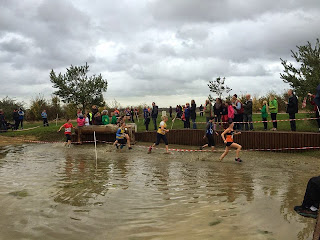
Make a splash: The water obstacle at Keysoe awaits at this October's Chiltern League race
Why do cross country?
  • To improve your fitness: Running off-road enhances your stamina and endurance. Tackling uneven surfaces and hills improves your muscle strength and core stability making you fitter and faster.
  • Less stress on your joints: Running on a softer surface gives your body a break from the impact of pounding hard surfaces like the road and track.
  • It’s scenic: As no course is the same, you could be running round farmland, through forests or pretty parks.
  • It’s suitable for ALL abilities: You don’t have to be super speedy and you don’t need to be able to run a marathon. Distances are usually 4k-8k for women and 8k-12k for men.
  • Contribute to the team effort: Just like the Midweek Road Race League, the cross country competitions we compete in are team events. The first to the last scorer all make a difference to where the team finishes.
  • Earn club champs points.
  • It’s free! Fully-paid up members of the club get free entry into all the league and championship race.
  • It’s friendly and fun! The races provide an opportunity to meet your clubmates, get into the team spirit and enjoy racing in the great outdoors.
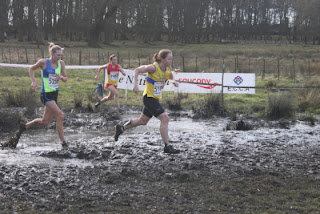
    Get stuck in: Some courses will be muddy!
CROSS COUNTY LEAGUES WE COMPETE IN

THE CHILTERN LEAGUE

Comprises clubs from Herts, Beds and Bucks, open to all abilities. Men and women race separately - approx 6k for women and 8k for men. There’s also junior races earlier in the day where St Albans AC athletes compete for Striders. The juniors, men and women’s scores are all combined to reach our league position.

Where & when:
Women’s race starts approx 1.15pm, men’s approx 2pm

Saturday 10 October, Keysoe Equestrian Centre, nr Bedford
Saturday 7 November, Milton Keynes (Teardrop Lakes)
Saturday 5 December, Culham
Saturday 16 January, Luton (Wigmore Valley)
Saturday 13 February, Milton Keynes (Campbell Park)
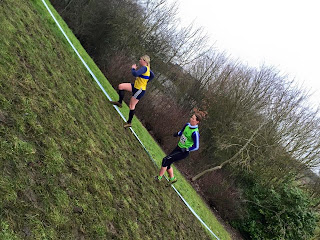
Milton Keynes is not flat! This hill features in the Teardrop Lake course

What to do: We need to declare with the organisers who will be running the night before each race. We’ll send an email and post on the message board the week before each race so please let us know then if you intend to run. On the day, collect a number from captains (Graham Smith for the men and Wendy Walsh for the women). As with the Midweek Road Race League, you must keep this number for the whole league. This year for the first time all races will be chip timed, with the chip being in the runner's number/bib.

More info: www.chilternccl.co.uk

THE SUNDAY LEAGUE
Slightly lower key league so a good introduction if you have never done cross country before. It’s suitable for all abilities and just like the MWRRL but on off-road courses. Clubs from the local area take part with men and women competing in the same race which is approx 5-6 miles. If you take part in four or more races you will be in with a chance of winning an individual age group prize at the end of the league. Individual trophies are awarded as follows: Senior Men, M40, and M50 - first five places. M60 - first three, M70 - winner. Senior Women, W35, and W45 - first five places. W55 – first three, W65 – winner.

Where & when: All races start at 10.30am
Sunday 18 October, Cheshunt
Sunday 22 November, Trent Park
Sunday 6 December, Stevenage
Sunday 17 January, Watford
Sunday 14 February, Royston
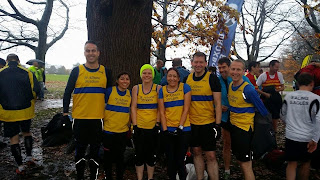
Who cares if it's raining?! The smiling team at a wet Sunday League race last season
What to do: We’ll advertise further details on each race in advance. You don’t need to wear a number so just turn up and race. At the finish, you’ll be given a ticket with your finishing position on which should be handed to the captains so they can record the results.

More info:
There’s no official website for the league but results and pictures will be posted on www.runherts.com.

CHAMPIONSHIP RACES WE COMPETE IN


Herts County XC: Sunday 10 January 2016, Stevenage

Individual and county medals up for grabs here and the chance to qualify to represent Herts in future races. Approx 8k for women and 12k for men.
What to do: You must have been born in Herts or have been a resident in the county for at least nine months prior to the race to compete. Captains have to enter teams in advance so look out for details on the message board or via email in order to sign up. On the day, collect your number from captains.
More info: http://www.hertscaaa.org.uk
Charge! The uphill start at Parliament Hill
Southern XC Champs: Saturday 30 January 2016, Parliament Hill, London
Regional event made up of clubs from the south of England. Approx 8k for women and 15k for men.
What to do: Open to all club members of all abilities but you must be EA registered pre-entered by captains. Look out for posts/emails to sign up nearer the time. The event is chip-timed so you must collect your chip and number from captains on the day.
More info: www.seaa.org.uk

The National XC Champs: Saturday 27 February 2016, Donington Park, Leicestershire

Prestigious and historic event which clubs across England take part in. Approx 8k for women and 12k for men.
What to do:
Open to all club members of all abilities but you must be EA registered pre-entered by captains. The event is chip-timed so you must collect your chip and number from captains on the day.
More info: www.englishcrosscountry.co.uk

Vet Champs: There are also a couple of Vets only championship races (age 35/40 and over for women depending on the event and age 40 and over for men) across the season including the Southern Masters Champs on Saturday 12 December (venue TBC), and Herts County Vet Champs on Sunday 13 March at Watford. You must be pre-entered so look out for email/posts nearer the time.

Please note when signing up for championship races we have to pay per entry and it can be costly to the club if we have a lot of drop-outs on the day - so please only sign up if you are committed to racing.

CROSS COUNTRY RELAYS


Southern XC Relay: Saturday, 17 October 2015, Wormwood Scrubs.

Team event involving clubs from the South which is a low key, fun start to the cross country season.
Teams: Women, 3 x 3k, Men, 4 x 5k
What to do: Sign up now! Open to all club members of all abilities but you must be EA registered pre-entered by captains. Deadline for entries is 3 October.
Thumbs up! The women's team at the National XC
National XC Relay:  Saturday 31 October, Berry Hill Park, Mansfield, Nottinghamshire
Well-supported national event where clubs from around England compete in teams around a course that’s not challenging and is great for spectating.
Teams: Women, 3 x 3k, men, 4 x 5k
What to do: Sign up now! Open to all club members of all abilities but you must be EA registered pre-entered by captains.
 
And finally here’s a list of essentials you will need for cross country racing…

  • Striders vest: You must compete in a club vest for all the above events.
  • Layers: Wrap up warm with hats, gloves and a waterproof jacket before and after the race. Some courses can be exposed to the elements and races will go ahead come wind, rain or shine (only very heavy snowfall has cancelled races in the past).
  • Spikes/trail shoes: Some courses will be suitable for trainers, but if the weather gets wetter and ground gets muddier, trail shoes or spikes are essential. If you only plan to buy one or the other, trail shoes are more flexible as they give good grip in muddy sections but are more comfortable on courses which include harder surfaces such as gravel. Cross country spikes can be bought for around £40 so are well worth having in addition to trail shoes as they give better grip on courses which are entirely grass/mud. Invest in some different length spike pins to insert in them so you can adapt the spike length according to the course (12-15mm best for very muddy courses like Parliament Hill).
  • Pins: For attaching your number.
  • Change of socks: The socks you run in might get wet and there’s nothing worse than travelling home with stinky, damp feet!
  • Wet wipes: Great for wiping all that mud off your legs (and arms and face!). Don’t worry about getting muddy, it’s all part of the fun and it all comes out in the wash!
  • Cake: For feeding your teammates after racing.
  • Sense of humour!
Don't forget wet wipes... and a sense of humour!
If you have any further questions about cross country running or want to find out more, contact men’s xc captain Graham Smith at men@stalbansstriders.com or women’s xc captain Wendy Walsh at ladies@stalbansstriders.com

Stayed tuned to the blog for a future post with tips on how to prepare for cross country racing!


We hope to see to you at the races,
Graham and Wendy,  XC captains

Thursday, 6 August 2015

How to keep on running for 12 hours: Top tips for those preparing for the St Albans Stampede

The inaugural St Albans Stampede - a 12 hour enduro race - will take place next month and if you haven’t entered yet, there’s still time to do so via the Active Training World website 

Completing such a long-distance event will be fun, rewarding... and a very tough challenge.
 
Careful preparation is needed if you are going to perform at your best, so with that in mind, here co-race director Nick Bradley gives his top tips on how to succeed in a 12 hour ultra…

1. Train specifically for the challenge

The Stampede is a trail ultra marathon so you need to prepare your body for running off-road. I’d suggest heading to Heartwood Forest and trying the route out in advance of the race - you’ll get a feel for the terrain, there may be the chance to practice running in mud (yes, mud!), and you’ll also test your fitness on the undulating hills.

The other key thing to think about is the distance. It’s likely that the winning solo participant will cover more than 60 miles during the course of the day, so you need to think about how far you want to go! This doesn’t necessarily mean doing lots of 30-50 mile training runs, but you need to get used to being on your feet for a couple of hours at a stretch.

Another crucial thing is to remember to practice walking because you could end up doing a lot of it - and that is absolutely fine - walking isn’t cheating when it comes to ultra marathons!


2. Invest in the right gear to get you through

Shoes: Get fitted properly and invest in a pair that works well for you and your running style. Remember to size correctly to take into account the time you will be on your feet and how your feet may swell. I’d also suggest considering a pair of comfortable trail shoes to protect your feet and provide extra grip on certain sections of the course.

Clothing: This should be as comfortable as possible, lightweight, and moisture wicking. Also consider multiple layers to accommodate for changeable weather. As the event is on a circular route, you can always leave spare gear waiting for you at the race HQ… and trust me, you want spare gear! A change of socks half way though can be a life-saver, as can a waterproof jacket if it starts to rain.

Hydration: Water will be available at the race HQ so you can stock up each lap. But I’d certainly recommend carrying water, even if that is simply a hand-held bottle. Some people go for hydration packs from brands like Salomon or Ultimate Direction which have the dual benefit of helping carry other items like a phone, camera or iPod (to help cure the potential boredom from running for 12 hours!), or food. The choice is really yours and what you feel comfortable with. I tend to favour a hydration vest which carries multiple gear and bottles.

Food: Again, some nutrition and supplies will be available each lap at the race HQ. But it’s always best to bring some of your own gear, focusing on the stuff that works for you. THIS IS VERY IMPORTANT! Some people like gels, others need real food. I always recommend having some electrolytes in tablet or drink format. The key thing is that your body will burn a lot of energy and you have to replace this energy, little and often, approximately every 20-30 minutes. Don’t forget to eat!

Other essentials: It’s often the little things that make a big difference. Don’t forget an anti-chaffing product such as Body Glide to rub on feet, nipples etc to prevent blisters and sores. A hat is useful to protect from the conditions - whether that’s shielding your face from the sun, wind or rain. And I carry always toilet paper in a backpack… just in case.

If you need to buy anything visit, Ultramarathonrunningstore.com. They are our event partners for the Stampede and will be giving all entrants a 15% discount code for purchases up until the event.
3. Plan your race strategy in advance

Ultra marathons are as much about getting your head in the right place as your body. I find the best way to feel confident going in to an event is to plan as much as I can in advance. What pace will I try and run at? Will I start off slow and build up, or go hell for leather from the beginning? Will I take breaks at the race HQ during the day? How often will I eat? What will I do if that niggling calf injury flares up?!

It’s impossible to predict everything and you simply won’t know how you’re going to feel on the day. But one thing usually happens to everyone in all ultras – there will be a point where you want to quit and you’ll question why you’re doing it in the first place. Strange as it may seem, the fun comes from taking yourself beyond this point and exceeding what you thought were your limits. If this is your first time tackling an ultra, have a think about that feeling in advance and it will certainly help on the day.

4. Don’t try anything new on race day

This one is a classic, and it still astounds me how many people ignore such sage advice… especially when considering an ultra marathon. If you’re running a 10k, you may get lucky throwing on those brand new running shoes and avoid suffering from blisters and sore feet. But new shoes worn for 12 hours is a completely different story. Your feet swell the more time you spend in them, the chance of getting blisters is greater, why take the risk? The same applies for clothing, nutrition etc – stick to what you know works for you.

The golden rule is – try everything during training first, not on race day.

5. 12 hours simply too much? Take on the Stampede as a team!

The Stampede is designed to be a challenging but fun event. If 12 hours solo running is not your thing, get a team of 4, 6 or 8 together and make a day of it. Some people dress up, others have a mini picnic set up with music, it’s common for supporters and family members to come along throughout the day to be part of the atmosphere.


Need some more tips? Here’s what Striders who have run ultra races before recommend…
  • Break the race up into small achievable chunks and focus on finishing that rather than the whole 12 hours, in the case of this event it’s easy to do so by breaking it up into laps.
  • If you're in a team make sure you're all on the same page regarding goals – is the aim to have fun or to win?
  • Teams should prepare an area in which to relax between runs as you might be hanging around a while. Take camping chairs, picnic blankets and warm waterproof clothing in case the weather turns bad.
  • Power walk up hills and run effortlessly down hill to save energy.
  • Scheduled walking breaks. Walking early and often can be hard when you feel good at the start of a race, but will likely increase the chances of a strong finish.
  • Ask friends and family to come and support you by cheering you on, shouting motivational slogans and ensuring you’re eating enough.
  • Don't stay too long at the food station. Grab what you need, put it in a sandwich bag and carry on going. Walk if necessary.
  • Take on food early and often. Start with savoury foods and move onto sugary ones - boiled potatoes, peanut butter sandwiches, ham sandwiches, biscuits and dark chocolate make good on-the-move snacks. 
  • Bring as much spare kit as possible including shoes. Change your socks often… but don't look too closely at your feet!
  • For a sugar hit, take a bottle of coke but de-gas it in the week of the event so it’s not fizzy. 
  • Pack paracetamol in the event of needing a painkiller. Do NOT take anti-inflammatory drugs such as ibuprofen as these can cause potentially fatal kidney problems when taken during endurance events.
  • Don’t be afraid to talk to fellow competitors – ultra runs can get boring so having chat can help pass the time.
  • After the event, don't sit down for too long. Keep moving to prevent yourself from stiffening up.
  • You may not enjoy every minute but enjoy as much as possible!
This is our first year running the event, and on behalf of the Striders, we hope that runners and spectators have a brilliant time so it can become part of the annual running calendar - providing a challenge to those taking part and inspiration to those watching.

If you have any questions, please get in touch via stampede@stalbansstriders.com or visit http://stalbansstampede.com. See you on Saturday September 5!

Tuesday, 14 July 2015

Jack Brooks tackles the UK's toughest road marathon, follows in the footsteps of Steve Prefontaine and avoids a grizzly bear in his latest races


JACK'S RACES APRIL TO JUNE 2015

Run Around the Reservoir Trail Marathon, Northampton: 5th April 2015

This is a 6 lap trail marathon organised by my friends, Dave and Linda Major. Graham Ridley, who used to be a driving force in St Albans Striders when I first joined the club and who emigrated to Australia around 2000, had run the race with me 2 years ago and wanted to run it again this year whilst on a short return visit. Consequently we both entered the race and decided to run the first 3 laps together. After this we had a right battle with probably no less than 200 metres between us for the rest of the event. I led until about mile 25, but then Graham swooped and finished a whole 28 seconds ahead of me. His time was 3:48:48 and mine was 3:49:16. We were both overjoyed to get under 4 hours for the first time on this course.

Huddersfield Marathon: 19th April 2015 

This marathon bills itself as “possibly the toughest road marathon in the UK”. After the 2nd mile there were some brutal uphills and some equally vicious downhills and we had the extra thrill of knowing that with a 2 lap course we’d have them all to contend with a second time. From early on I decided that this was a race where pacing myself would be really important. I finished the first lap in 2:05 and then gritted my teeth. On the second lap only one person overtook me and I found that I was steadily passing other runners. Most commented on the difficulty of the route and one joker pointed out that even one of the underpasses was sloping upwards. I was extremely relieved to get to the finish line in 4:26:43. This won’t be a marathon that I rush back to run a second time.

London Marathon: 26th April 2015 

As usual there was great support around the course from the Striders contingent. However, my legs still felt heavy after Huddersfield Marathon and I finished in 3:50:01.

Milton Keynes Marathon: 4th May 2015 

The course was described as gently undulating, but I found the relentless ups and downs pretty testing. I rediscovered in the second half why I hate underpasses and the hill at 24 miles was a killer. All in all I didn’t enjoy the race although once again the support around the course from a large Striders contingent was greatly appreciated. My time was 4:04:00.

Riga Marathon, Latvia: 17th May 2015 

After travelling to Macedonia and turning up for the start of Skopje Marathon only to be told that the Government had ordered the race to be cancelled for “security reasons” (which we later found out to be a major gun battle north of the city) it was nice to find that Riga Marathon definitely was going to proceed. I’d picked up a slight cold in Skopje and this stayed with me for Riga, where it was perpetually chilly and rained every day (particularly on the day of the marathon). There were around 1,400 runners taking part in the marathon and 4,000 in the half marathon. The start was close to my hotel so I didn’t bother with a drop-bag. There are no hills in Riga so my race plan was to start off with the 3:45 pace group. However, by about 16k I realised that I was going too fast and dropped back. I eventually finished in 3:57:00, grabbed my finisher’s medal and walked back to my hotel to get dry and warm as quickly as possible. 


Walled City Marathon, Derry, N.Ireland: 31st May 2015 

I enjoyed this marathon so much in 2014 that I decided to make a return visit this year. In addition my friend, Rich Holmes from North Carolina was running his 500th marathon at this event. The race was as good as I had remembered although it was windy in places. My time was 3:53:10 and I was 2nd vet 60/64.
 
Heartland Series Minnesota Trail Marathon, Great River Bluffs State Park, Winona, USA: 7th June 2015 

Roger Biggs from Stevenage and I spent a couple of days in Wisconsin visiting friends before driving down to Minnesota for this trail race. We’d been advised that trail shoes would be required, but I don’t think anybody had anticipated quite how bad the weather would be on race day. After a night of continuous thunder and lightning we drove to the State Park ready for the 5am race start. Fortunately both the thunder and the lightning stopped about 20 minutes before the race start, but it was still raining cats and dogs. The fact that it was raining heavily and that the race route was largely through a wood made visibility difficult and underfoot conditions hazardous and after virtually everybody had fallen at least once the organisers switched the route to a gravelled track, which wasn’t too badly potholed. I’d run 4 laps along the initial course, which left me with 13 laps of the out and back “revised” route to run. About halfway through the race the sun made an appearance and the heat became the new problem. I was relieved to finish in 4:51:31 (15th out 0f 83 runners and first vet 60 plus).

Dam Trail Marathon, Oakridge, Oregon: 13th June 2015 

After flying from Twin Cities to Seattle we picked up a 2nd hire car and visited friends in Yakima, Washington for a few days. We then drove to Oakridge for their marathon. Our friends, Rich and Jeanne Holmes had been keen to find an event in Oregon after the Eugene Marathon switched dates. Rich was planning to complete his 5th marathon circuit of all 50 States and Jeanne was due to complete having run a half marathon in all 50 States. We’d also arranged to meet Tom Detori and his wife, Eileeen at the race. Tom is an old friend who I’ve run with many times and who helped me get round Des Moines Marathon in 2007 when I was injured and really struggling. The majority of the marathon route comprised a circuit of Round Hills Creek Lake and about 40% of the course was on rough potholed gravel tracks and footpaths with the remainder being on tarmac roads. It was hot at the race start and remained so throughout the race. However, the scenery made up for this and I thoroughly enjoyed myself finishing in 4:05:13 (14th out of 46 runners and 1st vet 60 plus). From Oakridge Roger and I drove to Coos Bay for sightseeing and to visit the birthplace of the legendary distance runner, Steve Prefontaine. The Oregon coastline was spectacular and I also got to talk to someone in the Tourist Information office who had taught Prefontaine when he was at school. 

Mayo Midnight Marathon, Mayo, Canada: 20th June 2015 

We drove from Coos Bay to Seattle Airport where we met up again with Rich and Jeanne Holmes for our flights to Whitehorse in The Yukon, which appears to be the furthest airport in the North of Canada to which Canadian Airways fly. We spent 2 nights in Whitehorse exploring the area and visiting the longest wooden fish ladder in Canada before driving around 250 miles North to Mayo on the Friday. The race was at 8pm on the Saturday night so in the morning we drove further North to visit Keno, which is still a large silver mining area. With sunset at around 12.30am there is pretty much 24 hour daylight in Mayo at this time of year and it was still very warm at the start of this marathon. The route was effectively 13.1 miles out to a turning point along an undulating highway and then back. What gave the race a slight edge was the fact that this is grizzly bear territory. I suffered in the heat, but fortunately I didn’t encounter any wildlife along the route. However, a bear crossed the road in front of the runner who was 3 places behind me. I’m glad I only found out after the race had finished. The only downside to finishing the race after midnight was that mosquitoes were out in force and as a result I returned to England with plenty of very itchy “souvenirs”. Unusually the largest age group in the race was the 60 plus age group and I was 3rd vet 60 plus in a time of 4:20:12 (10th overall out of 15 runners), having been pipped to the post by a couple of Polish runners. 


Herts Hobble Trail Marathon: 28th June 2015 

This year’s Herts Hobble started from Buntingford. It is a route-description event and took us through some beautiful countryside and picturesque villages. While Liz Walls disappeared into the distance Adam Mellor and I ran round together finishing in 5:49:00. This was a good day out.